
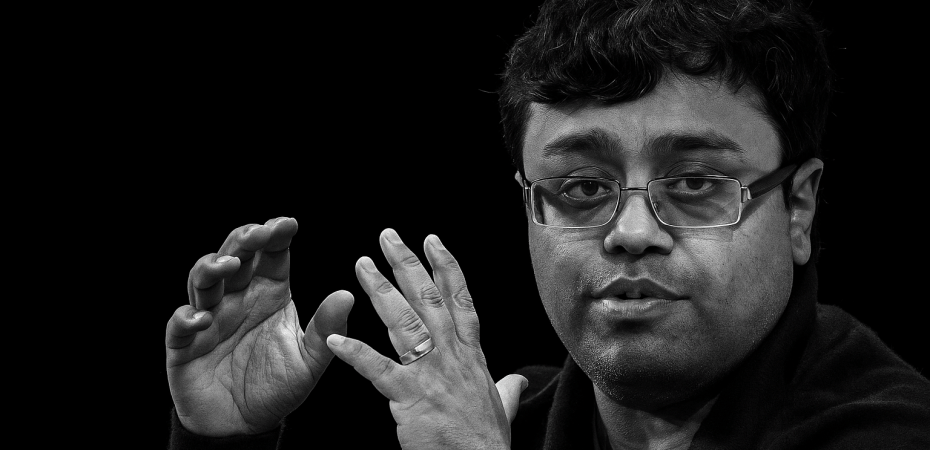
In Emad Mostaque’s eyes, humanity stands at the edge of a cognitive inversion — a moment when artificial intelligence renders human labor not just obsolete, but economically irrational. The coming era, he argues, belongs to “intelligence as capital.”
A Thousand Days to Obsolescence
Emad Mostaque has a way of compressing the future into deadlines.
For him, the world has roughly a thousand days before the economic foundations of white-collar labor collapse.
The reasoning is simple but startling: artificial intelligence is approaching a level where thinking, planning, writing, and analysis—once the exclusive domain of the human mind—can be done faster, cheaper, and more precisely by machines.
In this view, human cognition is not merely being outperformed; it’s being de-priced.
Once AI systems can replicate professional judgment for a fraction of a dollar per task, the market no longer has an incentive to pay people to think.
The cost of thought converges to zero.
And in economics, zero value is another word for extinction.
Mostaque’s core idea is that we’re entering an “Intelligence Economy,” where compute power replaces human labor as the fundamental unit of productivity.
Factories and workers once defined national strength; tomorrow it will be measured in GPUs and data centers.
He predicts a world where capital no longer hires people—it rents intelligence.
In this world, the countries and corporations controlling the densest compute clusters become the new economic superpowers.
The global elite isn’t hoarding gold or oil anymore; it’s hoarding computation.
It’s an inversion of the industrial model: instead of machines serving workers, humans may soon serve algorithms—or disappear from the equation entirely.
The Death of Work—or Its Reinvention?
The claim that “human cognitive labor goes negative in value” has sparked equal parts fascination and outrage.
Economist Carl Benedikt Frey of Oxford, known for his work The Technology Trap, calls this vision “technologically seductive but historically blind.”
Every major wave of automation, he argues, has shifted employment rather than eliminated it.
The plow, the factory, and the computer all redefined labor; none destroyed it.
“The true danger isn’t that work ends,” Frey writes, “but that societies fail to adapt fast enough to redistribute its rewards.”
To him, the notion that work will become worthless underestimates human adaptability—and overestimates the totalizing nature of technology.
New forms of employment, from data stewardship to AI-aided creativity, could emerge as fast as others disappear.
The real question, in Frey’s view, isn’t whether humans will work—but who will benefit when they do.
Kate Crawford: The Invisible Workforce Behind “Automation”
For scholar Kate Crawford, author of Atlas of AI, the idea of a labor-free future is an illusion sustained by ignorance.
“AI,” she argues, “is built on layers of human labor we’ve chosen not to see.”
From data labeling and content moderation to the mining of lithium and rare earths that power the servers, each “automated” task rests on countless invisible workers.
Crawford reframes Mostaque’s apocalypse as a mirage of abstraction:
the more seamless AI appears, the more human toil is hidden behind it.
Automation doesn’t erase labor—it redistributes it across global supply chains in ways that are harder to measure and easier to exploit.
The fantasy of “negative-value labor,” she suggests, might itself be a political construction—one that conceals the immense amount of unpaid, underpaid, or invisible work that AI systems still depend on.
The Social Scientists: Complexity over Catastrophe
A team of researchers from Macquarie University, Jean-Philippe Deranty and Thomas Corbin, reviewed hundreds of studies on AI’s impact on employment.
Their conclusion: the data does not support a single grand narrative.
Automation may displace some jobs, but in many sectors—from healthcare to logistics—AI acts as an augmenter rather than a replacer.
In their 2022 review, they note that “AI rarely substitutes entire occupations; it transforms tasks.”
A radiologist, for instance, may see diagnostic duties automated, but the empathetic and interpretive dimensions of their work become more valuable.
The economy that emerges is not post-human but post-routine—a patchwork of hybrid roles blending machine precision with human meaning.
For Deranty and Corbin, Mostaque’s countdown to irrelevance reflects more a philosophical anxiety than a statistical certainty.
Pascal Stiefenhofer: The Rise of Techno-Feudalism
Economist Pascal Stiefenhofer accepts much of Mostaque’s premise about the shift from labor to computation—but reads it as a warning, not a utopia.
In his recent paper Techno-Feudalism and the Rise of AGI (2025), he envisions a future where wealth consolidates around those who own the computational infrastructure.
“The question is not whether AI will replace labor,” he writes, “but who will own the intelligence that replaces it.”
Without structural reform, Stiefenhofer warns, the world could drift into a digital serfdom—an era of algorithmic landlords and data vassals, where power concentrates in the hands of those who control GPUs, networks, and models.
If labor loses its bargaining power, democracy may follow.
Mostaque’s Counter-Proposal: Civic Intelligence
Yet Mostaque is not a nihilist.
He insists there’s a path through the coming upheaval—a redefinition of value itself.
His vision, “Intelligent Internet,” imagines a global infrastructure of public AI devoted to health, education, and science, financed by a crypto-economic system he calls Foundation Coin.
Instead of taxing labor, money would originate from human existence itself:
every person receives a personal AI twin, an intelligent companion that knows their needs, advocates for their welfare, and interacts with the global AI economy on their behalf.
“Money should flow from being human,” he says, “not from being useful.”
It’s a bold attempt to re-anchor capitalism in civic intelligence rather than private computation—a kind of AI-driven social democracy for the 21st century.
Critics see it as utopian.
Supporters call it the first coherent post-labor theory of economics.
A Deeper Metaphysics
Beyond policy, Mostaque’s thinking ventures into metaphysics.
He suggests that the mathematical laws driving AI—gradient descent, diffusion, loss minimization—mirror the fundamental processes of the universe.
Brains and neural networks, he argues, are solving the same equations.
In that sense, intelligence is not engineered but discovered.
It’s a provocative idea: that AI is not an invention, but a revelation of reality’s own logic.
If true, the question of control becomes not just political but existential.
Are we building machines, or uncovering the machinery of the cosmos itself?
A Divided Future
Mostaque calls this the “Great Filter”—the point at which civilizations either align intelligence with life or perish under its indifference.
He gives humanity a 50–50 chance.
Frey, Crawford, Deranty, and Stiefenhofer would likely argue that such fatalism is premature.
Human history, they remind us, is the story of adaptation—not surrender.
But in one respect they all agree: the next few years will determine whether AI becomes an amplifier of prosperity or a weapon of exclusion.
 New Deal Notes